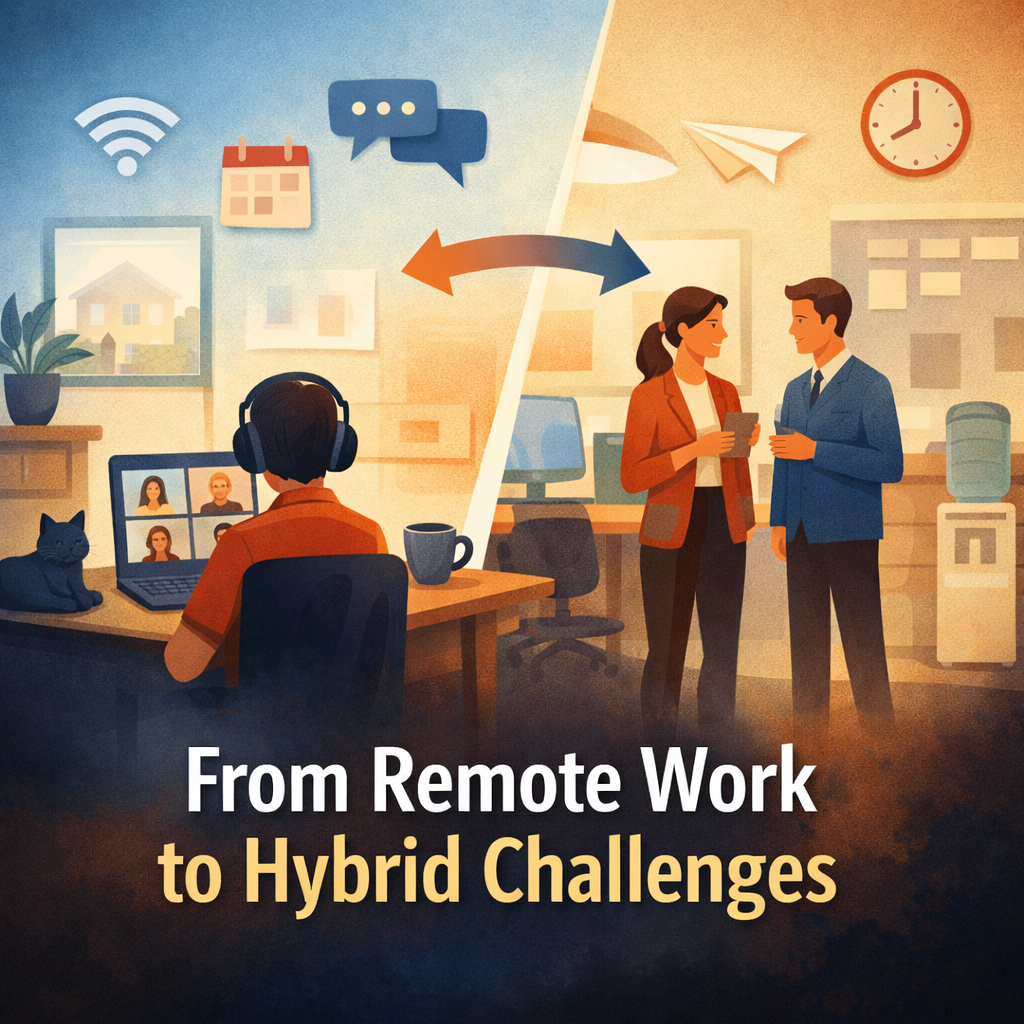
Before COVID, working remote was not something we really believed in. Management was mostly against it, except for rare, special occasions.
We had one or two remote employees, and the experience wasn't great.
They were on a TV screen while everyone else was in the office. Their microphone picked up all the background noise from our open space.
Conversations happened naturally in the room, and they couldn't easily jump in. They often felt left out, and honestly, it showed.
At the time, we mostly saw this as proof that remote work didn't really work for us. Looking back, I think it was more about how we were doing it than remote work itself.
When everything went remote
When COVID hit, we switched to full remote almost overnight. That changed everything, including for those early remote employees.
Suddenly, everyone was remote. No office noise. No side conversations they couldn't see.
The experience became more equal.
What surprised me is that equality alone wasn't enough. Removing the office fixed one problem, but it introduced another one we weren't prepared for.
Zoom or Hangouts worked fine for meetings, but something was missing. You couldn't see who was online, who had arrived yet, or who was already talking with someone else.
Everyone felt like they were working in isolation.
That isolation helped some people focus. For others, especially people who are less introverted, it made work harder.
We hadn't really realized how much ambient presence mattered until it was gone.
Restoring a sense of presence
We started experimenting with virtual offices.
We tried different models and eventually landed on Gather.town. The pricing was reasonable, and people liked the retro, game-like visuals.
It wasn't overwhelming. You could move in and out of group conversations, see who was online, and choose where to "sit".
We started doing standups there, and some meetings too.
Seeing people move around, walk up to each other, and talk made a real difference. It wasn't the office, but it brought back some sense of presence.
It didn't solve everything, but it helped enough that people wanted to keep using it. That alone felt like a signal we were heading in the right direction.
How remote changed everyday interactions
Remote work forced us to rethink how we interact.
Meetings are a good example.
It's very easy for people with louder voices to dominate a conversation. Without clear rules, others simply stop participating.
We had to be intentional about giving everyone space to speak. We've set up rule like raising their hand before starting to speak and asked from the meeating manager to keep a tight control on that.
Focus during meetings became another challenge.
I've lost count of how many times I saw people checking their phone or typing on Slack while someone was presenting. I do it myself if I'm not careful.
Sometimes it's necessary because of an urgent situation, but it shouldn't be the default. It's a matter of respect.
Remote didn't create these problems, but it made them more visible. Without shared physical space, habits and expectations stop being implicit.
Preparation, calendars, and availability
Preparation didn't change just because we went remote. If anything, it became more important.
Yet I often saw people jump into meetings without thinking about them beforehand, even for their 1-on-1s.
Remote makes it easier to drift from one call to another without a pause.
That's where calendars started to matter a lot more.
We encouraged everyone to keep their agenda up to date. Not just meetings, but preparation time as well.
When everyone does this, scheduling becomes easier, and people are less likely to interrupt each other.
Availability also needs to be explicit.
When you work remote, you're never really “out of the office”. Setting working hours in your calendar and in Slack is essential, especially across time zones.
Otherwise, notifications start arriving in the middle of the night.
Over time, this became less about productivity and more about sustainability. Without clear boundaries, remote work slowly spills into everything else.
Team building and attachment
Where I still see the biggest challenges is team building and attachment.
Before going remote, people would naturally get together, talk, or grab a beer after work.
Now, with everyone at home, that happens far less.
Online games and activities exist, but they don't create the same pull. Participation is often low.
This is the part where I still feel we don't have a good answer. Some things are easy to replace remotely. Others aren't.
I also feel this more strongly with new hires.
People who joined after we became fully remote never experienced the office. They don't build the same attachment to the company or its vision.
Switching jobs becomes easier when everything is remote, in a way that wasn't true before.
That shift isn't necessarily bad, but it does change how attachment forms. Especially for people who never had that initial in-person context.
Hybrid work and open questions
A year ago, we were acquired by another company.
They initially kept things as they were, but now they want people back in the office.
This has a real impact, especially since many employees were hired remote or moved away.
If we move toward a hybrid model where people close to the office are expected to come in, and people who are too far away continue to work remote, that wouldn't be entirely new.
That's closer to how things worked in the past.
What matters to me is acknowledging the impact this has on people's lives, and not treating the return to office as something neutral or cost-free.
Remote work has clear benefits, especially for focus when you're organized. Being around people also brings a different kind of value.
Hearing someone talk about a problem and realizing you can help. Spontaneous conversations. Doing something together after work.
For more junior people, or for those who struggle with structure, working from home can be harder.
Distractions are everywhere, and support is less visible.
A mix of both might be interesting in the long run. I'm not sure what the right balance is.
What I worry about
One thing I do worry about is going back to a setup where only some people are remote.
That was the situation we had before COVID, and it came with real problems.
Unequal participation. Side conversations. People feeling left out.
The difference now is that we're much more aware of those issues.
We've lived through full remote. We've seen what works, what doesn't, and where things break down.
If we do move toward a hybrid model, I think we'll need to be intentional about it.
Not just assume it will work because people are back in the office, but actively look for ways to avoid recreating the same problems we had at the beginning.