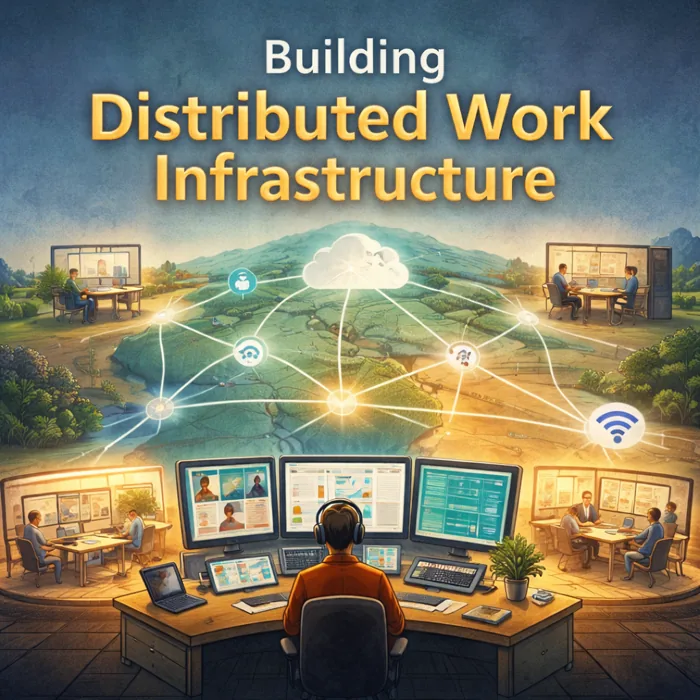
When we first tried to support remote work before COVID, the infrastructure wasn't there. We had people on screens while the rest of the office talked around them. Microphones picked up noise. Conversations flowed naturally for those in the room, and nowhere else. Looking back, it wasn't that remote work didn't work. It was that we didn't have the tools or structure to make it work. When COVID forced us fully remote, we had no choice but to build what was missing. This isn't about whether remote work is good or bad. It's about what it takes to make it function at scale.
Recreating presence
Once everyone moved home, we discovered something we hadn't fully anticipated. Zoom worked well for scheduled meetings, but something important was missing in between. You couldn't see who was online, who had just arrived, or who was already in a conversation. The ambient presence that comes naturally in an office was gone. For some people, that absence was ideal. Quiet, focused, uninterrupted work. For others, especially those less comfortable working alone, it felt like working in a void. No sense of who was around. No easy way to jump into a quick conversation. No visibility into what the team was doing. We realized we needed to recreate something the office had always provided without effort: a shared sense of presence.
We experimented with several virtual office tools. Eventually, we landed on Gather.town. It wasn't perfect, but it solved a real problem. You could see who was "in the office." You could move between conversations. You could choose to be present or step away. The game-like visuals made it feel lighter, less formal, and less demanding. Presence became a choice, not an obligation. We used it for standups, casual meetings, and the kinds of interactions that normally happen when you bump into someone at their desk. It wasn't a replacement for the office. But it restored a form of visibility into each other's presence. And that mattered more than we expected.
Making work explicit
Remote work also exposed a problem that had always existed but was softened by physical proximity: unstructured meetings don't work well. In a physical room, some people naturally take space. Others fade into the background. Remote amplified that. Without clear norms, participation dropped. A few voices filled the call. Everyone else stayed muted. We had to be intentional. Raising hands before speaking. Managers actively managing turn-taking. Explicitly inviting quieter people into the conversation. It felt like extra effort. But in reality, it was just making explicit what should never have been implicit.
In an office, availability is visible. You're at your desk, or you're not. Interruptions happen based on what people see. Remote removes that signal. And without it, everything becomes interruptible. Meetings bleed into each other. Messages arrive at all hours. Work stretches into evenings and weekends because you're always technically reachable. We learned that calendars became infrastructure. When everyone kept their calendar up to date - meetings, focus time, preparation, breaks - scheduling improved. Interruptions decreased. People stopped trying to reach each other late at night. Making availability explicit wasn't about control. It was about sustainability. Without boundaries, remote work doesn't stay healthy. Calendar discipline and clear working-hour norms in Slack became essential tools.
The harder problem: connection
Some infrastructure problems have workable solutions. Others don't, or the solutions feel forced. Onboarding remotely is hard. People who joined after we went fully remote never experienced the office. They built different relationships with the company and with each other. That changes how connection and belonging form. Team bonding is another challenge. Before remote, people grabbed a beer after work or talked on the way out. Online games and virtual happy hours exist, but they don't pull people in the same way. Participation is uneven. The spontaneity of physical space doesn't translate cleanly. We tried different approaches. Some helped. Others didn't. I don't think we ever fully solved this part.
Building distributed work infrastructure taught me that it's not a single thing. You need tools that recreate presence. You need meeting norms that enforce structure and protect focus. You need calendar discipline and explicit boundaries. And you need to accept what can't be replicated. Most of all, you need to be intentional. Remote work doesn't work by default. It has to be designed, maintained, and adjusted over time. That infrastructure is what we rely on now. If the model changes again, we won't just be changing where we work. We'll be dismantling one system and building another. I used to think remote work was mostly a policy debate. I now think it is primarily an infrastructure problem.
- Patrick