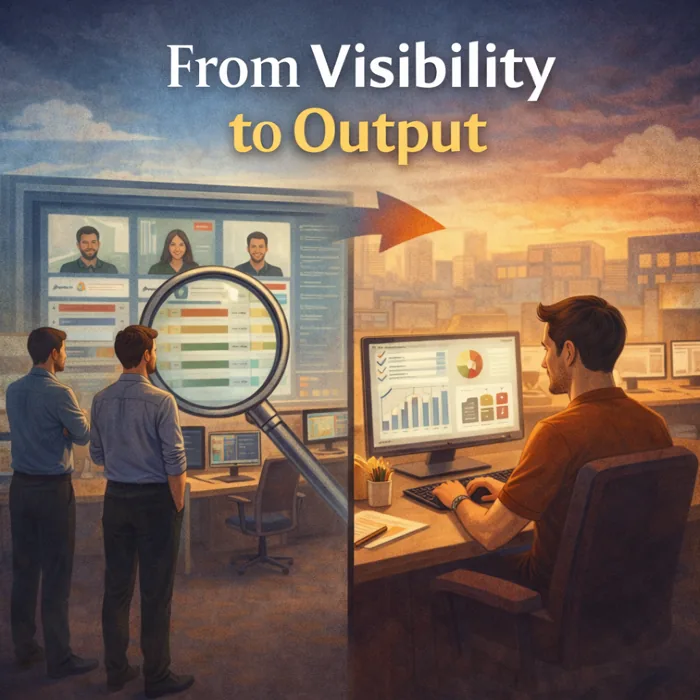
In the office, management was often shaped by what you could see. Smoking breaks, YouTube on screens, people arriving late or leaving early. Our open space made everyone visible, and that visibility quietly became a proxy for performance.
I spent years in that environment. People came to me with observations: someone takes too many breaks, someone listens to music while coding, someone leaves at 5:30 instead of 6. They expected action, and I did act. I had conversations with people about how their behavior looked to others.
Those conversations were uncomfortable. No one wants to feel watched or judged. Over time, I started questioning the premise. If the team was delivering, did those visible behaviors actually matter? Or was I managing perception instead of work?
The visibility trap
In an open office, visibility feels like management. You can see who is at their desk, who is talking, and who looks busy. It creates a feeling of oversight and control.
But what you see is partial and random. You form opinions from fragments. Someone taking many breaks may be distracted, but they may also be thinking, recovering energy, or solving a difficult problem. Visibility tells you activity, not necessarily value.
There is also a behavioral cost. When people know they are being watched, they optimize for looking busy. And real work often looks like nothing: quiet time, dead air, and slow thinking. I learned that managing visibility is exhausting, and often wrong.
When we went remote, that model disappeared overnight. I couldn't see screens anymore. I couldn't tell who stepped away. I couldn't form impressions based on visible activity.
For many managers, that was unsettling. Without visibility, how do you know people are working? For me, the answer became clearer over time: focus on output. What gets delivered, how teams collaborate, how work progresses, and whether commitments are met. The shift took adjustment, but once it clicked, it felt liberating.
Output as a signal
Output is a more honest signal than visibility ever was. Sprint progress cannot be faked for long. Poor performance appears as delays and gaps. Strong performance becomes clearer, especially for people whose working style looked "less active" in the office but produced consistent results.
I also realized output-based evaluation is fairer. It doesn't matter when someone works, how many breaks they take, or whether they look busy. What matters is what they deliver and how they contribute.
Output isn't a perfect metric. Some work is harder to quantify. Some contributions don't map cleanly to tickets or pull requests. But it's still a better signal than judging activity.
Moving away from visibility-based management meant giving something up. I gave up the feeling of minute-by-minute control and had to rely more on trust.
In practice, that turned out to be a feature, not a bug. People generally respond well to trust, and I became better at my role by focusing on outcomes instead of optics. Over the last few years, output metrics, regular check-ins, and shared progress made the work clearer and healthier.
Going back
Now we're moving back to the office, and I find myself revisiting this lesson. When people share physical space, visibility returns, and with it the temptation to manage what is easiest to observe.
I don't want to go back to that. Five years of output-based management convinced me it works better, feels fairer, and keeps focus where it belongs.
The real test is whether I can hold onto that discipline when visibility is available again. I think I can, because I know what the alternative looks like, and I don't want to repeat it.
- Patrick