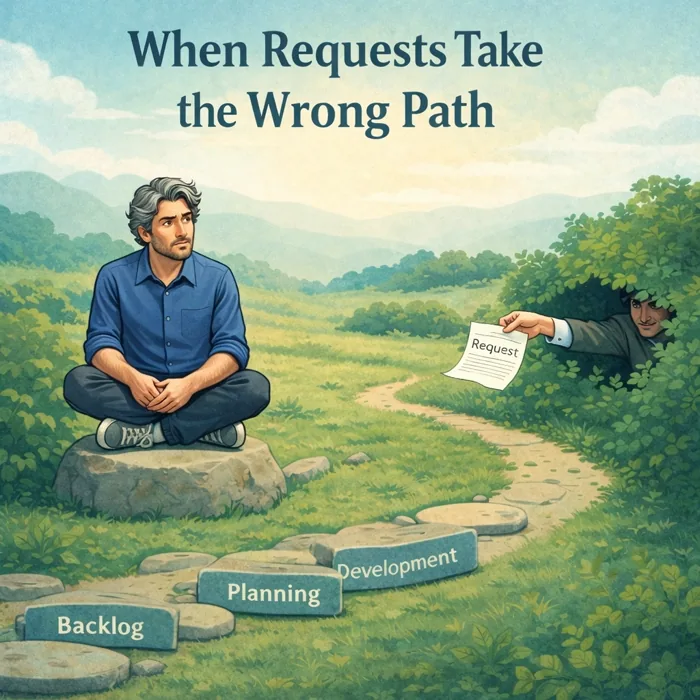
Over the years I've worked in several roles around development. I started as a developer, moved through project management, and eventually ended up managing development teams. That perspective gave me the chance to watch how requests actually move inside an organization: an idea appears somewhere, goes through some level of prioritization, reaches a team, gets built, and eventually comes back to the stakeholder.
On paper, that path usually made sense. If a request was not prioritized, there were often valid reasons for it. The benefit might not be clear, success might not be measurable, or the team might already be committed to work that mattered more at that moment.
The pattern was that the formal process and the real path of a request were not always the same thing. When stakeholders felt their ideas were not moving, the request sometimes found another way forward.
When requests bypass the process
Instead of going through the usual prioritization process, the request would arrive through a different channel. Sometimes the stakeholder contacted the product owner directly. Sometimes they reached out to a developer. Being on the receiving side of that is not always comfortable, especially for the people at the end of the chain who are expected to execute the work.
When someone with influence asks for something directly, it can feel difficult to push back. Most of the time the request gets done anyway, but it often arrives with missing pieces. The specifications are unclear, the expected outcome is vague, and success criteria are rarely defined.
The team does its best to deliver something useful, but the result does not always match what the stakeholder had in mind. Occasionally the idea works well, and that may reinforce the behavior by making it look like bypassing the process was the right move.
Why stakeholders go around the process
There are several reasons why this happens, and not all of them come from impatience or bad intent. Sometimes the process itself is too heavy. Too many approvals, too many forms, or too many steps before something even reaches a team. In those situations, stakeholders may simply try to shorten the path.
Other times the request starts more casually. Someone mentions an idea during a meeting, and another person treats that comment as an actual request. People with decision authority run into this often. A remark made in discussion can quickly turn into an implicit priority because others assume it should be acted on.
I have also noticed this happening more often during periods of change inside a company. Layoffs, reorganizations, or leadership changes can make ownership less clear. When people are not sure who is responsible for what anymore, requests start moving in different directions as everyone tries to respond to the expectations around them.
When multiple teams get involved
The situation becomes more complicated when more than one team is involved. A request may start in one team and then extend to another team that needs to provide part of the solution. By the time the second team receives it, the original context may already be missing.
That team still tries to help. People start spending time understanding the problem, discussing options, and planning the work. At that point the request can already be well underway before anyone realizes that it never went through the usual process.
Stopping it can feel counterproductive because time has already been invested. Over time, I started seeing that sunk effort as a weak reason to keep going. In many cases, pausing is still the right move, especially when the teams involved are solving different versions of the problem.
Taking a step back
I came to see that the first instinct should not be to keep the work moving at all costs. Earlier in my career, I tended to see forward motion as the safer choice. If people were already engaged, it felt easier to keep going than to interrupt the momentum.
In practice, that usually made the situation worse. The most useful step turned out to be much simpler: pause for a moment and bring the right people together. Instead of trying to resolve the issue through side discussions, it helps to gather the key people involved and clarify the request in one conversation.
The questions are usually straightforward. What is the real goal of the request? What would success look like? Which teams are involved, and what part does each team own? This kind of conversation often resets the situation before more time is spent in the wrong direction.
It clarifies the work that actually needs to be done, but it also helps stakeholders understand how requests normally move through the organization. Meeting the people responsible for different parts of the system makes the path more visible the next time a similar need appears.
Looking back at the process
Situations like this can also be a useful moment to look back at the process that was bypassed in the first place. Processes are usually created for good reasons, but over time they can become harder to navigate than intended. Too many steps, too many approvals, or simply something that is not obvious to people outside the team.
When that happens, people will naturally look for another path. That does not mean the process should disappear, but it may mean it has accumulated more friction than anyone intended. I started seeing these moments less as exceptions to correct and more as signals that the system itself might need attention.
Over time, I also started seeing requests that take the wrong path as a visibility problem more than a prioritization problem. Once a request starts moving through side channels, people are often reacting to pressure they can feel but cannot fully place. The work becomes harder not only because the request is unclear, but because ownership, intent, and decision-making are no longer visible in the same place.
These situations create more friction than the request itself deserves because they expose how easily alignment can drift when the path of the work is no longer shared. Protecting that shared path matters as much as evaluating the request, because once it disappears, even reasonable ideas become harder to handle well.
- Patrick