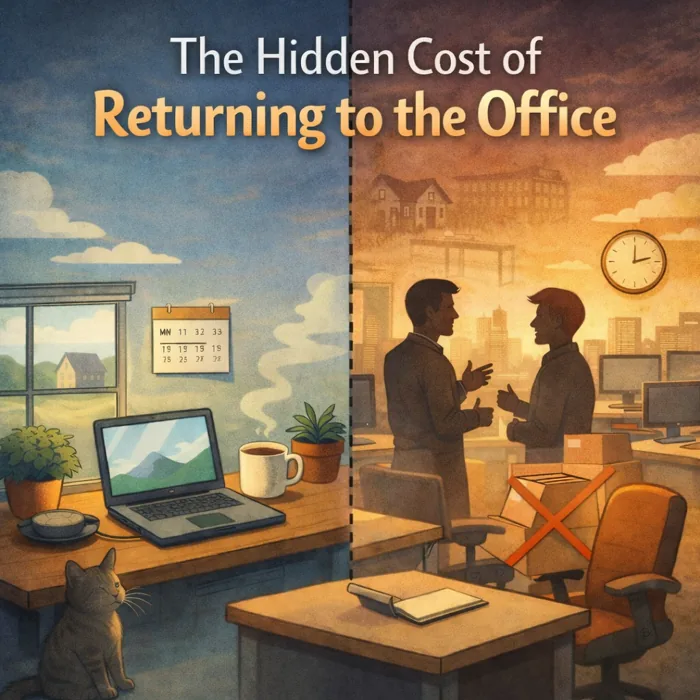
After years of working remotely, we received an email last December announcing a return to the office. It landed heavily. Not because I was against being around people again. I wasn't. But because I knew what the shift would cost, and no one was talking about that.
What people adapted to
For the past five years, everyone working here made decisions based on remote work being permanent. Some moved closer to family. Others moved to places they wanted to live, not places where jobs existed. Many reorganized their days around having mornings back, flexibility around school pickups, or time with their kids before work started.
Those weren't casual decisions. They were commitments. People bought houses. Moved in with partners. Changed how their families operated. They built lives around the assumption that this way of working would last. And then, suddenly, it wasn't going to last. The organization wasn't trying to be cruel. It was doing what made sense from its point of view: consolidating office space, bringing people together. From an operational standpoint, those are reasonable decisions.
From a personal standpoint, they come with real costs.
The uneven impact
Returning to the office doesn't affect everyone equally. Someone who stayed in the original city loses very little. Someone who moved away faces a hard choice. You can lose the job. Lose the house. Lose the balance you built. Or undo years of decisions to return to something you thought you had moved past.
For some people, that's manageable. They can adapt again. They can move back. They can find something closer. For others, it isn't really a choice. A partner's job is tied to the new city. Kids are settled in school. Roots are down. Adapting again isn't an option. Leaving is. That's part of the cost of a shift like this. Not everyone pays it the same way. Some absorb it quietly. Others take it as a signal to look elsewhere.
The hybrid problem
Before COVID, we tried hybrid. Some people remote, most in the office. It was awkward then, and it will be awkward again. I remember the setup. Screens and cameras at team desks. Microphones picking up everything. Remote people trying to follow conversations they couldn't quite hear. The office full of energy that remote people could sense, but not really join. It's not that hybrid models are impossible. It's that models where most people are together and a few are remote create friction. Conversations happen in the room. Remote people hear fragments without context, or miss them entirely. Side discussions happen at desks. Decisions get made in passing. Remote people learn about them later. It's not intentional. It just happens.
The physics of presence work against people who aren't there. Over time, that creates a social cost. People who are remote start to feel slightly out of sync. Not excluded, exactly. Just not fully in the flow. Present, but not quite part of it.
What we learned that we might forget
Five years of remote work taught us some things. We learned that output matters more than activity. That people are more productive when they're trusted. That different people thrive in different environments. That flexibility has real value. Going back to the office doesn't have to mean forgetting those lessons. But I worry that it will. That visibility will quietly become the proxy for productivity again. That presence will replace outcomes. That we'll start policing activity instead of measuring results. We also learned that changes to how we work have costs. Real ones. And that those costs aren't evenly distributed.
Who Pays for the Reversal
I keep thinking about the people who will leave because of this. Not because they dislike the company, but because they built lives somewhere else. Because a two-hour commute was never part of their plan. Because their partner's job is elsewhere. Because their kids are settled.
I keep thinking about the people who will stay, but with resentment. Who moved once for remote work and now have to undo that decision. Who uprooted their family only to be asked to uproot them again.
I keep wondering whether organizations fully account for that cost when they make these decisions. Not just the operational logic of "we need people here," but the actual impact on people's lives. Remote work worked. It had limits and challenges, but it worked. And it changed a lot of lives. Some for the better.
Now, some of those lives are about to be disrupted again, in ways that aren't always acknowledged. That's the hidden cost. Not the difficulty of hybrid setups, though that's real. But the personal cost of asking people to adapt again, after they already did, after they built something stable around what they thought was permanent.
I used to think these decisions were mostly about operating models. Over time, I started seeing them as continuity decisions with uneven personal consequences.
- Patrick