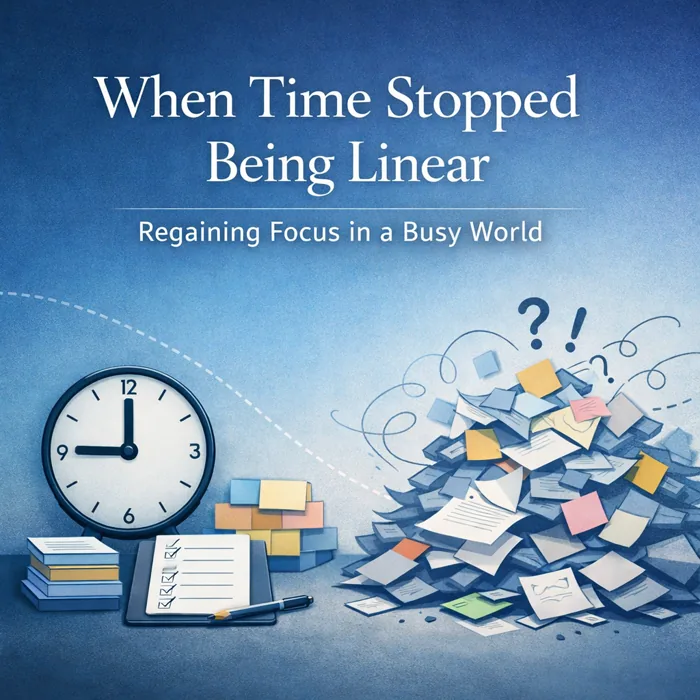
Managing my time was not always a struggle. Early in my career, it felt easy. I was given tasks, worked through them, and left at the end of the day without carrying much with me. I could focus on one problem at a time. Even when I kept thinking about it outside of work, it was still just one thing. Work felt linear. That changed gradually. First when I became a lead, then more noticeably as the team grew. Around the same time, life grew too. Two kids, more responsibilities, more things competing for attention. Nothing broke suddenly. The simplicity just faded.
When memory became the bottleneck
One thing I underestimated was how much I was relying on memory. I tried taking notes during meetings. I tried writing summaries of what was said and what we agreed on. In theory, it should have helped. In practice, it didn't. I wasn't consistent. Meetings were back to back. There was no pause to organize what had just happened. When I did reread my notes later, I often skipped parts because I couldn't remember the context anymore. By the end of the day, I had the feeling I had talked a lot, decided many things, and remembered very little. That's when I realized the problem wasn't effort. It was scope.
I started looking for ways to get things out of my head. That's when I came across GTD, Getting Things Done. I didn't adopt it perfectly, but I took one core idea seriously: externalize everything. Tasks, follow-ups, ideas, commitments. If it mattered, it had to live somewhere other than my memory. That change alone made a big difference. Not because I had less to do, but because I knew what I had to work on, and when. I stopped jumping blindly from one thing to the next, only seeing the mountain. It reduced stress mostly because I wasn't afraid of forgetting anymore.
What structure can and can't do
That structure isn't free. Maintaining a task list takes discipline. Reviewing it takes effort. There are things I keep pushing back because I don't like doing them, and that makes the list heavier over time. Sometimes I fall out of the habit. Sometimes I avoid the review. But the benefit is still higher than the pain. Enough that I keep coming back to it. What mattered most wasn't perfection. It was having something to return to.
Even with a well-organized list, things still happen. Emergencies. Curveballs. Problems no one saw coming. Sometimes they take the whole day, or more. When that happens, the plan breaks. And that's fine. The real risk is not the interruption itself. It's forgetting to go back to the list afterward. It's easy to fall back into old habits and just react to the next small thing. So the work becomes less about planning perfectly, and more about remembering to re-prioritize once reality has shifted. That's what keeps the system alive.
- Patrick